

Why Today’s ABA Requires More Than New Buzzwords

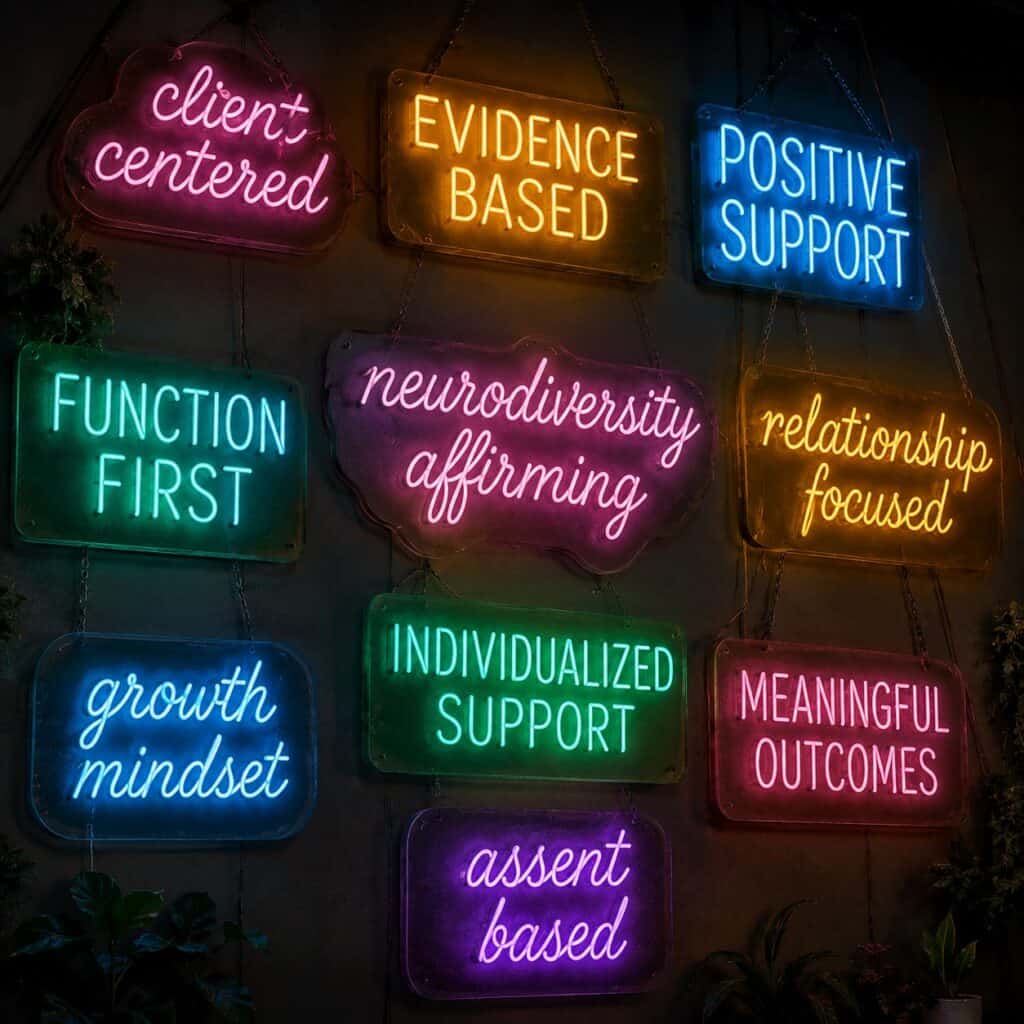
Over the past several years, the field of ABA has changed significantly.
Conversations about assent, neurodiversity, trauma-informed care, autonomy, and disability rights have become much more common. More practitioners are questioning older approaches and looking for ways to create services that feel more supportive and respectful.
I think that is a positive shift.
Many of these conversations are happening under labels such as assent-based ABA, neurodiversity-affirming ABA, and trauma-informed ABA. As more behavior analysts and ABA providers explore these approaches, there is growing interest in what meaningful change actually looks like in practice.
These conversations matter. Listening to autistic voices matters. Thinking critically about our practices matters.
But I also think there is a risk that can happen during periods of change.
Sometimes we start treating new language as evidence that progress has already occurred.
And those are not always the same thing.
It is possible to use all the right terminology while continuing to make many of the same decisions.
It is possible to describe services as neurodiversity-affirming while still focusing on goals that are primarily designed to make someone appear more typical.
It is possible to talk about autonomy while offering very little meaningful choice.
It is possible to describe ourselves as trauma-informed without fully understanding disability, sensory differences, communication differences, or the lived experiences of the people receiving services.
Learning new terminology is relatively easy.
Changing how we think can be much harder.
The shift happening in ABA right now is not simply about replacing one set of buzzwords with another. It is about developing a deeper understanding of the people we support.
Modern ABA requires more than adopting new terminology. It requires examining how clinical decisions are made, how goals are selected, and whether interventions are truly aligned with the needs, preferences, and quality of life of the individual receiving services.
That means learning from autistic self-advocates. It means learning about disability justice. It means understanding autism research, developmental research, communication research, and other areas that can help us better understand the individuals we work with.
It also means being willing to learn outside of behavior analytic journals.
Some of the most important advances in autism support have emerged through collaboration across disciplines. Autism research, communication research, developmental science, disability studies, and lived experience all have valuable perspectives to offer behavior analysts who want to continue improving their practice.
One of the challenges I see in our field is that many professionals stay almost exclusively within behavior analytic literature. While there is valuable information there, there is also an entire world of research happening in other disciplines that can help us become better clinicians.
The people we support do not experience life through the lens of a single profession.
Neither should we.
The goal should not be reaching a point where we feel like we have finally figured everything out.
The goal should be continuing to learn.
Continuing to question.
Continuing to grow.
And continuing to ask whether the services we provide are helping people build the lives they actually want to live.
That kind of reflection matters far more than any buzzword ever will.



Responses